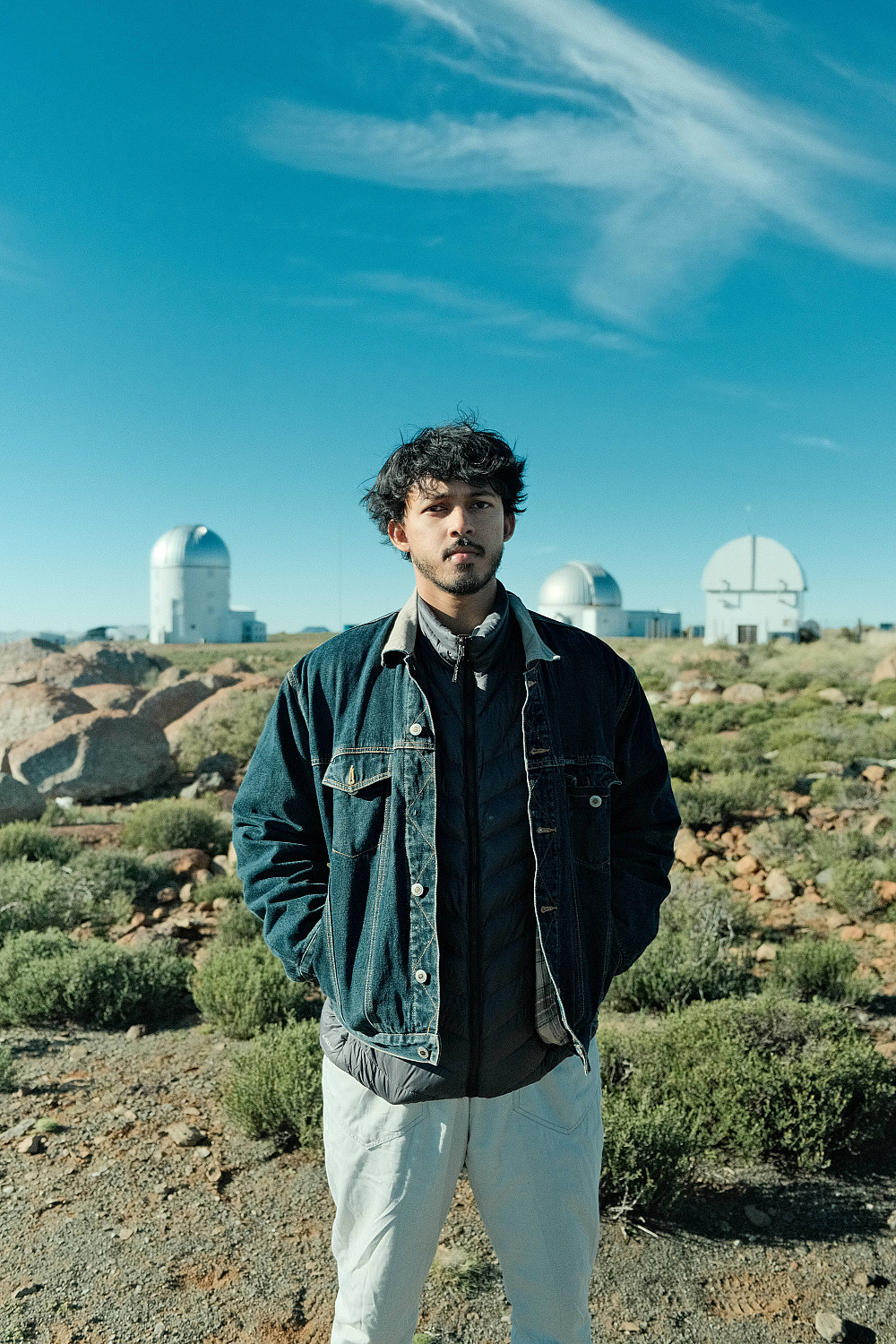
Javett-UP presents String Theory, a solo exhibition by Kamil Adam Hassim
Press Release
17 September 2026
From 17 September 2026 to 27 March 2027, the Javett Art Centre at the University of Pretoria (Javett-UP) is excited to present String Theory, a solo exhibition by artist and cosmo- technologist Kamil Adam Hassim. Bringing together archaeology, astronomy, sound and instrument-making, the exhibition asks how people come to perceive realities beyond their immediate senses, and what happens when ways of knowing are lost.
The exhibition begins with traces of deep human time, including the remains of extinct hominin species such as Homo naledi and Australopithecus sediba found in South Africa. These fragments reveal lives that can only be partially reconstructed. String Theory places that absence alongside the loss of languages, stories and knowledge through conflict, colonialism and cultural erasure. It asks how different cultural and technological instruments shape what a world makes available to perception.
At the heart of the exhibition is String Theory, an installation in which a particle detector drives a family of speculative string instruments known as the Sutras. High-energy cosmic rays interact with Earth’s atmosphere, producing showers of secondary particles. The detector registers particles that reach the gallery, principally muons.
Signals from those detections activate electromagnetic drivers positioned at the instruments’ strings, causing the physical strings to vibrate and produce sound in the gallery. The sound arises from the instruments themselves: a chain of interactions links radiation arriving from beyond Earth, particles formed in the atmosphere, a detector and acoustic matter. The installation makes an otherwise imperceptible event perceptible through its effects.
“I think of scientific, cultural and spiritual practices as different instruments of perception. Each makes certain aspects of reality available while leaving others invisible,” says Hassim. “String Theory asks what happens when these instruments are brought into dialogue—when a particle detector becomes part of a musical instrument, and phenomena normally beyond human perception physically act upon the space around us.”
Hassim’s practice operates at the intersection of art, frontier science, and indigenous knowledge systems. His work investigates how different cultural and technological frameworks produce different realities and the social, technological, and spiritual possibilities they offer.
These questions also reach into the present. Human beings have long used tools, languages and cultural practices to interpret their surroundings; today computational systems and planetary infrastructures increasingly mediate what can be seen, known and shared. Rather than treating technology as a simple break from nature, the exhibition asks what kinds of worlds different technologies allow us to perceive and inhabit, and whose knowledge they
preserve or exclude.
Across sound, sculpture and scientific apparatus, String Theory connects deep time to the present through a question about perception: how might we build instruments that extend our senses while remaining attentive to the ways of knowing that history has obscured or erased?
String Theory is curated by our Interim Curatorial Director Storm Janse van Rensburg and Javett-UP’s curatorial team.
Visitor Information
Exhibition dates: 17 September 2026 - 27 March 2027
Opening hours:
Tuesday to Saturday, and the last Sunday of every month
10:00–16:00
Admission
R80 Adults | R50 Pensioners and under 18s | Free for children under 6, registered tertiary students, UP staff, and active ICOM and SAMA members
Bookings are open at Webtickets. Walk-ins are welcome for self-guided visits.
Guided tours
From R400 per group and can be arranged at least 48 hours in advance by emailing [email protected].
Images: https://drive.google.com/drive/folders/1ca9mMJL_nzRsMu5ellrwQVAhUlVsKSfG?usp=sharing
ENDS
Issued by the Javett Art Centre at the University of Pretoria (Javett-UP)
For inquiries, please contact
Thakgatso Monisi (Audience Engagement and Communications Coordinator)
E-mail: [email protected]
Phone: 0788233596
The Javett-UP is a space that enhances unique and exceptional transdisciplinary learning through the arts. The centre engages diverse publics in exploring the human condition and reimagining our futures. The Javett-UP is a partnership between the University of Pretoria and the Javett Foundation. Both share a firm belief in the value of the arts for society in general and education. It’s a project that is collegiate as it is philanthropic. With one foot firmly rooted in academia, and the other embedded in the public, Javett-UP aims to make the art of Africa accessible, relevant, and engaging. It is our commitment to continuous de-colonial dialogues that respond to the present whilst considering the historical and the future implications of our political and social action.
About Kamil Adam Hassim
Kamil Adam Hassim (b.1997, Durban, South Africa) is an artist and cosmo-technologist whose practice operates at the intersection of art, frontier science, and indigenous knowledge systems. His work investigates how different cultural and technological frameworks produce distinct realities and the resulting social, technological, and spiritual possibilities they make available.
During his Master's programme at the Michaelis School of Fine Art, Hassim was awarded the prestigious Connect residency at the European Organization for Nuclear Research (CERN) and the major Astronomical observatories in South Africa for his work and research. These engagements have grounded his practice in dialogue with scientific communities working at the limits of perception and measurement.
Central to Hassim's work is an inquiry into how different knowledge systems (scientific, cultural, and spiritual) shape the perception and organisation of information. Drawing on diverse fields, Kamil works across a vast range of media and techniques. His polyvalent practice often results in plural forms and pushes material boundaries, treating aspects of space-time, matter, and energy as artistic media.
