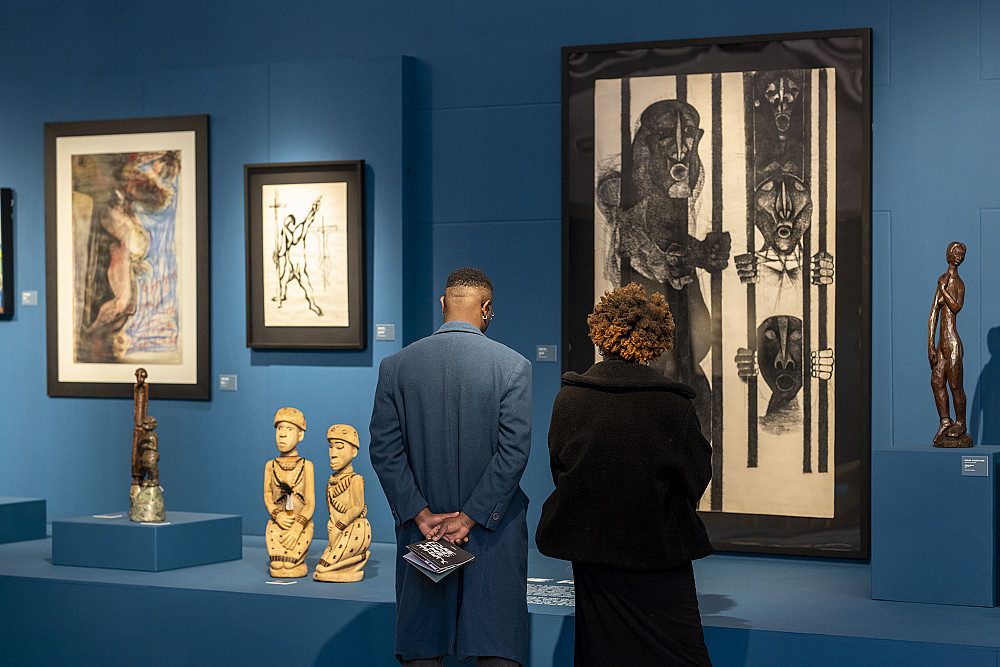
The Many Ways of Seeing the ‘One and The Many’
Reviews
14 July 2026
Written by Rory du Plessis, Associate Professor in Visual Culture Studies, School of the Arts, University of Pretoria
There is a common belief about art galleries that on entering the space, a viewer is estranged from the outside world and is confronted by the ‘genius’ of the artist whose artworks can only be deciphered by art critics and art historians. The exhibition, the ‘One and The Many’ troubles and topples such a belief by inviting viewers to find their own personal interpretations in the works, and in the viewers embarking upon exploring the works, they will soon come to recognise that the works are intimately tied to the world outside the gallery.
I invite you, the viewer, to take your time in viewing each artwork and give yourself the chance to be amazed, awe-struck or gaze in gleeful wonderment at the works. Once refreshed and released to see anew, you are now ready to find your own meaning in the works. The search for meaning may pertain to aesthetics and beauty, but it has more to do with engaging with the artist’s intent and the meaning of their work as an evocation to expand your horizon, teach you something anew, or shift your perspective. Here the focus is on the artwork and transforming or reinvigorating the meaning of your life. In the six sections that follow, I provide a testimony of my personal engagement with the artworks. It is my hope that if each visitor seeks a personal engagement with the artworks, we will truly achieve many meanings of the ‘One and The Many’.
I
“how can we care for the planet if we do not care for one another /
how can we care for one another if we do not care for the planet?”
– Antjie Krog (2022: 106)
Religion is inseparable from analysing Jackson Hlungwani's works. For Hlungwani, a lay preacher, his sculptures were intended to communicate God’s message and many of his works were crafted for spiritual use in the sacred environment of the church he founded. Academics and art critics have at length explored how his works contain a blend of motifs from Christian and African visual traditions and therefore their focus is on how his sculptures present a fusion of multiple influences and religious elements. The findings presented by these authors aid our appreciation for the aesthetic, formal and symbolic qualities of the sculptures as works of art, but how would we go about to interpret a personal spiritual meaning in the works? To embark upon such an exploration entails shifting our attention away from iconographical studies, to explore how the viewing of the work is an invitation to mediate on themes of the care of life. These themes are implicit within theo-ethics that C.J. Kaunda (2003: 42) defines as the “radically humane way of becoming and being committed to creating new possibilities for the flourishing of human beings and all things”. Kaunda (2003: 48) locates such possibilities in the Zulu greeting, Sawubona, which means “‘I-we’ deep gaze at you” and carries with it the acknowledgement that the addresser recognises the dignity, value and worth of the addressee, as well as an acknowledgement that both parties see one another as the embodiment of “collective encounters, exchanges, and experiences of eco-relations” (Kaunda 2003: 48). To gaze with Sawubona eyes thus means:
to see beyond the appearances or observables of the phenomenon to see the humanity of another, see the cosmos, see all life as it manifests in its singular eco-self in time and space. There is no encounter without deep seeing into reality. The person who has lost the capacity to deep see into reality is essentially disentangled from the self or estranged from the cosmic self. That is a cosmic sin. A cosmic sin is that sin that cannot … hear the excruciating “groaning in labour pains” of creation (Roman 8: 22), that cannot see the pain, suffering and corpses of the living neighbours (Luke 10:25-37), cannot hear the unsettling silent moans and imperceptible sufferings of women and sexual minorities (John 4:4‑26). (Kaunda 2003: 50).
I invite the viewer to gaze at Hlungwani’s Angel Figure with Sawubona eyes, and thus to look beyond the material work to meditate on caring for the sacredness of another and for all life forms. This could take the form of becoming aware of those around us who need us to be their angel – to feed them, to protect them and give them respite. By extension, it would also be to embrace the Soft Vxnxs by Goldendean and consider how to become allies for trans people. Thus, seeing with Sawubona eyes means viewing an artwork to contemplate the sacred and spiritual, and thereafter to let our eyes open our heart to guide us in our daily actions to protect and respect the sacredness of all life.
A common trope in the exhibition theme ‘The Garden’ is the representation of animals as intimately tied to religion and scenes of African life. To elucidate, several of the works depict humans with wild animals, angels with animals, as well as Africanised biblical stories featuring wild animals. These works allow us to extend our Sawubona gaze to consider our eco-relations with other species, and to explore the sacredness of non-human life forms. In the western canon of religious art, wild animals are represented as tamed under the dominion of ‘man/kind’. The biblical inspiration for this representational trope is Genesis 1:28 where God commanded humans to “have dominion over the fish of the sea and over the birds of the air and over every living thing that moves upon the earth” (NRSV). Here dominion is often interpreted as the power and right to rule or control the earth, yet dominion in a theological reading calls attention to the qualities of the “dominating rule of a king” (Brown 2009) who is called to care and save the lives of the needy, helpless and the oppressed. Thus, dominion in Genesis actually commands us to protect and restore the environment (Brown 2009). Many of the works of ‘The Garden’ can help us to see what such a revised interpretation of dominion entails. In the Mapula Embroidery, Village Scene (Leeu), a village is depicted as a few homesteads that are encircled by a diversity of plant and animal species. Here the village is recognised as a co-inhabited space where fauna and flora thrive and contribute to the vibrancy of village life. Mavis Shabalala’s Ingelosi Nezilwane (An Angel with Animals) presents a totem-like arrangement of a number of wild animals with an angel at the top. The angel is depicted neither as hierarchically above the animals, nor as the binary opposite of the animals. Rather, they are shown to be connected with one another and therefore the composition allows us to consider holiness as attributed to heavenly and earthy creatures. These works show a flourishing world for all, where humans, the earth and celestial beings are represented as connected to one another, sharing attributes of holiness, and in doing so, all life forms are envisaged as sacred.
In western philosophy, the theme of eco-relations is a cornerstone of several of Donna Haraway’s (2007, 2015) texts where she forwards the concept of companion species – the joint lives and interconnectedness of humans with other species. The concept allows Haraway to explore how the history, evolution and survival of humans in inextricably intertwined with the lives of other species. Accordingly, the survival of other species will thus ensure the survival of humans. In Mmakgabo Mmapula Mmangankato Helen Sebidi’s Mo Mahaeng ke Mathatha (At Home is Difficult), we see humans embraced and swaddled by several animal species. It is as if Sebidi demonstrates our interdependence with animals: that humans co-habit with animals and therefore our survival and sustaining is provided by the animal kingdom. Sebidi’s work alongside Haraway’s text inspires me to consider my stories of kinship, friendship, affinities and emotional connectedness to other species. I also come to recognise that as they sustain our survival, it is our responsibility to “join forces to reconstitute refuges” (Haraway 2015: 160) for their survival.
II
In the widely acclaimed On Photography, Susan Sontag (1990) explores the aesthetic and moral problems posed by photographs. While she concedes that photographs of war, suffering and abuse can produce moral outrage and thus inspire public advocacy and collective action to call for the end of such acts, the effect of the photograph ‘wears off’ once we become familiar with the image. In this sense, after repeated viewings, the moral weight of the photograph is lost. Thus, the same photograph that initially consciensitised the public to a social issue, will eventually anesthetise public opinion. Moreover, the emotional impact of the photograph requires an appropriate context and captioning to activate a viewer’s feelings, empathy and compassion. By following Sontag’s theorisation, the photographs that documented the horrors of apartheid might run the risk of losing their emotional meaning. The photographs of Sharpeville, of protests, of segregation, and the dehumanisation and exploitation of mine labourers, are reproduced in school textbooks and are freely available on online archives or web repositories. These photographs are synonymous with visualising the apartheid regime, and are often used to ‘illustrate’ a historical event or circumstance. Yet, seldom are the photographs explored in terms of emotional meanings, and even more seldom is an exploration that seeks to recognise that depicted in the images are people of flesh and blood who suffered greatly, and for whom we have a debt to honour their humanity. Here Sam Nhlengethwa’s photo collage series is notable for using the iconic photographs of the apartheid regime and reinvigorating their emotional impact by incorporating figures or scenes from other photographs. Nhlengethwa thus defamiliarises the original photograph from the standard historical context to invite the viewer to adopt an empathetic-looking where one sees a person and not a pixel, where one responds with weeping, grief for the suffering, and may potentially become consciensitised to advocate for historical justice.
In the exhibition theme ‘Image Worlds/World Images’, Nhlengethwa’s work is in dialogue with Jane Alexander’s photomontage works from the 1980s. While Nhlengethwa focused on photographs of the horrors of apartheid, Alexander’s series makes use of banal domestic, industry and city scenes from white apartheid South Africa and transforms them into images of atrocity and horror by combining them with images of her iconic Butcher Boys whom Ivor Powell (2007) deems as “the most enduringly iconic image of the sinister and apocalyptic brutalisations of apartheid”. In this way, the Butcher Boys haunt the images and unmask the banality of evil – that behind the façade of commonplace scenes lurked the monstrosity of apartheid. I welcome the opportunity to see the Butcher Boys resurface in 2025, and I hope that they will continue to haunt us so that we may never forget to stand up for the equality and freedom of all human beings.
Ledelle Moe’s work, ‘Undulation I’ and ‘Undulation II’ in its sheer scale, shape and form evokes reference to a memorial, and yet at the same time, the surface with its grid-like markings resembles the ropes that secure fabric to monuments to protect them during the process of de-installation. The work thus echoes a monument or memorial, yet also challenges such echoes by resisting the inclusion of a title or explanatory text that anchors it to commemorating a site, event or person. I argue that this resistance is a subversion of the traditional aims and principals of commemoration whereby dominant historical narratives are presented, and the public is instructed on how to feel, interpret and respond. To this end, the work can be interpreted as a countermonument, which seeks to encourage the public to be guided by personal acts of meditation and contemplation to commemorate the voices of the past. If we approach Moe’s work as an apartheid countermonument, we are thus tasked to confront what it means to bear a personal testimony of witnessing the voices of the past, as well as consider how we can personally seek to commemorate the stories from our painful past in our daily acts of living.
III
In the works by Kathryn Smith and Kim Berman, I wish to interpret them by engaging with the larger oeuvre of the artists. The 2004 work, Memento Mori, by Smith has largely been discussed within the aestheticisation of the dead female body, as well as an exploration in the relationship between art, violence and death. While the work speaks directly to how death is aesthetised in the western canon of art, the Smith of today explores the role of art in forensic practice and the creation of works to help identify unknown skeletal remains. By briefly sketching Smith’s current interest, we can explore new readings of Memento Mori where the focus moves away from the aesthetics of death in the works of art and fiction, to consider how various art forms serve an integral role in restitution and remembrance of the dead.
Kim Berman’s Fires of the Truth Commission II (1999) is part of a larger series where veld fires are a symbol for the TRC, which strove to document the apartheid regime’s wrongdoings in order to pave the way towards restitution, reconciliation and the regeneration of a democratic nation. Berman’s work pays tribute to the TRC, but when I see the work, I see Berman’s flame for igniting the visual arts to contribute positive social change in South Africa. Berman has been involved in multiple community arts projects and co-founded the Artist Proof Studio that incubates artists to be change-makers in the world. In this sense, while the TRC rejuvenated the new South Africa, Berman revitalised the role of artists to effect social change and to foster a vision for what our shared humanity looks like. The fire in Berman’s painting evokes a Turneresque painting and sculpts the landscape like waves of the sea, yet the beguiling beauty of the fire pales in comparison to those, like Berman, who are committed to making Ubuntu alive in their daily life by upholding respect, empathy and the well-being of all.
IV
We often characterise portraiture as pertaining to the physical likeness of the sitter and therefore believe that a portrait study is the product of countless hours whereby the sitter is mute, stationary, and passive in order to be meticulously dissected by the artist’s gaze. The result may be the physical likeness of the sitter, but for portraiture to become “alive” necessitates, according to John Berger (2017: 152-153), for the artist to paint from the impressions the sitter leaves the artist with:
When you’re trying to do a portrait of somebody else, you look very hard at them, searching to find what is there, trying to trace what has happened to the face. The result (sometimes) may be a kind of likeness, but usually, it is a dead one, because the presence of the sitter and the tight focus of observation have inhibited your response. The sitter leaves. And it can then happen that you begin again, referring not any more to a face in front of you, but to the recollected face which is now inside you. You no longer peer; you shut your eyes. You begin to make a portrait of what the sitter has left behind in your head. And now there is a chance that it will be alive.
It is the ‘aliveness’ of Gerard Sekoto’s Portrait of an African Woman / Parisian Scene (Recto-verso) that pierces my eyes and leaves me struck by a profound sense of the sitter’s strength of character. I attribute her aliveness to Sekoto’s decision to depict her outside of the conventions of the western art canon that locked blackness to the aesthetic of the primitive and exotic, and that confined African women to tropes of docility, sexualisation and domesticity. Sekoto’s sitter stands strong and proud: her neck is pronounced but not to emphasise femininity and sexuality, but rather to connote her strength of character to hold her head up high; her headdress does not evoke modesty and meekness but resembles a military beret; her facial expression is indicative that she has strength of will and determination; and Sekoto’s use of shades of blue and red clothe her body in an armour of resilience and force. In this way, Sekoto’s portrait may be the product of the impressions the sitter made on him, and how he aimed to present a testimony of her bold and confident character.
Santu Mofokeng’s Eyes Wide Shut, Motouleng Cave, presents a portrait of his brother, Ishmael at the Motouleng Cave – a site venerated by South Africa’s traditional animist religions as a place of healing. Ishmael had come to the site for healing having been diagnosed with HIV/AIDS and tuberculosis. Much has been written about how Mofokeng captured the frailty and imminent passing of Ismael’s life, but what has escaped attention is the possibility that Mofokeng may have decided to take the photograph to be honorific – to commemorate Ishmael’s life. Much of Mofokeng’s oeuvre – from The Black Photo Album and onwards – has been a commitment to the memorialisation of the black proletariat who sought to reject the world view dictated by colonialism and apartheid and instead carve out a life lived with dignity and pride. In this sense, I argue that Mofokeng’s portrait does not seek to capture a man dying of HIV/AIDS, but offers a poignant meditation of Ishmael as an individual, a brother, and a unique being. Thus, in the words of John Berger (2017), in a gesture of compassion, Mofokeng looked passed the clinical labels attached to his brother, and photographed the name of Ishmael’s soul – one who is loved and will be remembered as loved.
V
In contrast to the mythology of artists drawing inspiration from real-life muses and models, Marlene Dumas’s models are derived from popular culture and thus she argues, “The images I deal with are familiar to almost everyone everywhere. My ‘models’ have all already modeled for someone else. There ain’t no virgins here” (Dumas 1998). In Purple Pose (1999), the work is certainly inspired by the female poses in advertising, fashion, cinema and pornography. By intertextually referencing female poses from popular culture, Dumas may be commenting on the way the image-world has naturalised the sexual objectification of women. Yet, Dumas’s critique does not lead to re-objectifying the women she depicts, as she deploys abstraction, unblended stark colours, as well as watercolour-like markings in an attempt to blur out the subject. If we pair Dumas’s work together with Tracey Rose’s Ciao Bella – Lovemefuckme, we can extend the conversation of female objectification to include how patriarchy polarises the representation of women to be either: good and chaste ‘Madonnas’ who are worthy of ‘loving’, or as bad and seductive whores who are prized to be ‘fucked’. Rose’s work can be interpreted as staging the Madonna/Whore dichotomy to critique the patriarchal valuation of women while also performing, as a boxer in a self-harming solo fight, how abusive and destructive the dichotomy is to the psyche of women. In my reading of Dumas and Rose’s work, they show how the sexual objectification of women in the media conditions us to forget that when we see a woman on screen, we are beholding a person that shares our common humanity, and who ought to be treated with respect and equality.
VI
In Kudzanai Chiurai’s Congestion and George Pemba’s In the bus, I am enthralled by the figures holding onto the handrails. In Pemba’s work, the male figure’s pose is reminiscent of the raised fist of the Amandla rally cry against apartheid, while Chiurai’s figures look like people ziplining or performing feats of parkour. These figures index movement, agency and resistance, while also speculating on a hopeful future Africa. Pemba’s figure raises his fist for freedom, and appears to be personified as the liberty that will be won, and the democracy that will reign over South Africa. In this sense, the figure is raised as a placeholder monument to the future democracy, one that would eventually be taken up by statues of Nelson Mandela – that in themselves show uncanny formalist links to Pemba’s figure. If Pemba’s figure can be regarded as a harbinger of democracy, could Chiurai’s figures herald hope for a Afrofuturist cityscape where the citizens have freedom and access to self-enrichment and self-advancement? Along these lines, what I see in these works is the role of art to enable us to build tomorrow’s Africa and to imagine African futures that reflect the values of our constitution.
References
Berger, J. 2017. Portraits: John Berger on Artists. Edited by Tom Overton. New York: Verso.
Brown, C. 2009. Genesis 1:28, To “Subdue” and “Have Dominion Over” Creation. [O]. Available at: https://christopherbrown.wordpress.com/2009/01/03/genesis-128-to-subdue-and-have-dominion-over-creation/
Dumas, M. 1998. Sweet Nothings: Notes and Texts. Edited by Mariska van den Berg. Amsterdam: Uitgeverij de Balie.
Haraway, D. 2007. The Companion Species Manifesto: dogs, people, and significant otherness. Chicago: Prickly Paradigm Press.
Haraway, D. 2015. Anthropocene, Capitalocene, Plantationocene, Chthulucene: Making kin. Environmental Humanities 6: 159–165.
Kaunda, C. 2023. SAWUBONA. A theo-ethic for everyday decolonial gestures. Acta Theologica 43(1): 41-59.
Krog, A. 2022. Pillage. Translated by Karen Press. Cape Town: Human & Rousseau.
Powell, I. 2007. Inside and outside of history. Art South Africa 5(4):32-38.
Sontag, S. 1990. On photography. New York: Picador.
About Rory du Plessis
Rory du Plessis is an Associate Professor at the School of the Arts, University of Pretoria. He has pioneered the investigation of photographic records from South African psychiatric facilities as a resource to humanise the subjects who were institutionalised in the late nineteenth and early twentieth centuries. He is the author of Pathways of Patients at the Grahamstown Lunatic Asylum, 1890 to 1907 (PULP 2020), I See You: A Photo Album of People with Intellectual Disability (ESI Press 2023) and Automaton(tik): In Remembrance of the Patients of the Fort England Psychiatric Hospital (ESI Press 2025).
