The Tower at Javett-UP: Re-Imagined with Two New Exhibitions
Press Release
10 March 2026
The Javett Art Centre at the University of Pretoria (Javett-UP) is excited to announce two new exhibitions opening on 24 March 2026. The exhibitions provide an immersive experience, bringing together material culture and artistic production from the 1800s to the present. They explore themes of African Humanism, indigenous technologies, ancestral knowledge and the garden as a metaphorical site of creativity and imagination.
The Brenthurst Collection of Southern African Art
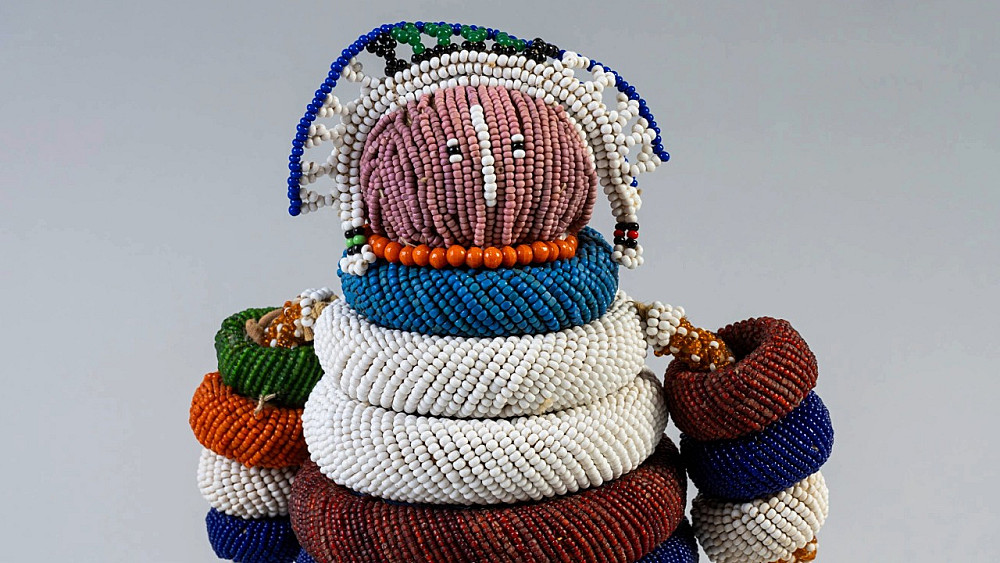
The exhibition, Orchard of the Imagination: Selections from The Brenthurst Collection of Southern African Art, explores Southern African material culture from the 18th and early 19th centuries as an expression of lived experience and knowledge. The collection was started by Jonathan Lowen in Johannesburg in the 1960s, continued in London for three decades, and was acquired by Harry Oppenheimer in the mid-1980s, returning to South Africa. It was on loan to the Johannesburg Art Gallery until 2023 and is now housed at The Brenthurst Library.
Framed through an African Humanist perspective, the exhibition approaches material culture not as static evidence of the past, but as an expression of lived experience and living knowledge that is shaped by skill, belief, memory, and imagination. The title of the exhibition is drawn from a text by Es’kia Mphahlele (1919 - 2008) for the exhibition catalogue for Art and Ambiguity: Perspectives on The Brenthurst Collection of Southern African Art, (1991) held at the Johannesburg Art Gallery.
Orchard of the Imagination is realised through vital partnerships with the University of Pretoria's Heritage Conservation Programme and The Brenthurst Library. Over two years (2023-2025), heritage, museum, and conservation students, overseen and guided by senior lecturers, conducted preventative conservation work on the collection. This included careful cleaning, stabilisation, and beadwork conservation. The process prioritised preserving signs of use and age, respecting each artefact's history rather than erasing it.
Maggi Loubser, Course Coordinator and Senior Lecturer for the Masters Programme in Heritage Conservation reflects, “Our program had its first intake of students in 2019 after three years of intense planning. Most of our alumni are now employed in the sector, and are making a huge impact on the recognition for conservation in the heritage sector. The importance of cultural heritage is related to our sense of belonging, a link to our past and our place in society. Heritage needs to be cared for, and with trained professionals permeating the industry, this message is enforced.”
Storm Janse van Rensburg, Interim Curatorial Director and curator of the exhibition states, “We are delighted to be able to bring to our audiences such rich, often unseen aspects of our extraordinary cultural heritage, and are indebted to The Brenturst Library for this incredible loan. We are also excited to bring focus to the important work of Heritage Conservation at the University of Pretoria - a trailblazing department working at the forefront of material culture conservation and care on the African continent.”
The exhibition is supported by the Australian High Commission.
Cow Mash Solo Installation: ditšwatšhemong
In dialogue with Orchard of the Imagination is an installation by Tshwane-based artist Cow Mash, titled ditšwatšhemong translated as “they come from the field / the origins of the land.” The title speaks to lineage, source, and belonging. It is both spatial and spiritual, understanding land as place and as memory, ancestry, and knowledge. The exhibition reflects Cow Mash’s practice of working across time while imagining speculative futures where indigenous knowledge systems and spiritual cosmologies coexist and evolve.
Beginning with masekitlana, an indigenous storytelling game, and closing with a familiar nursery song reinterpreted through Sepedi vowels, Cow intentionally creates an intergenerational space of play and learning. Viewers enter through a reimagined street-language environment that echoes everyday informal and survival infrastructures. Beyond the glass doors, the space shifts into an exploratory landscape of unidentified seedlings preserved in glass and cared for by the Balemi (farmers).Nearby, a quiet corner holds a waskom (metal bathtub) with migrating cows as an intimate moment of movement. As you enter the inner sacred space where waskoms and planters gather beneath the aerial view of tšhemong , you are invited to be the farmer, forming a sacred site of origin and becoming.
Puleng Plessie, Curator of Education and Public Programming and co-curator of the exhibition states, “Rooted in Cow Mash’s practice of lineage and matrilineal memory, the exhibition reflects her self-positioning as a transdimensional farmer: a figure who cultivates not only land, but memory, ritual, and future worlds.”
At its core, this exhibition is a search for the grandmother’s garden, a metaphorical site of abundance, knowledge, healing, and origin that runs through Cow’s practice. It is not a literal place, but a spiritual geography.
Jackie Rens, Chief Executive Officer of Javett-UP states, “We are excited about the possibilities that emerge with Cow Mash’s work and how the new exhibitions provide access points to complex cosmologies and expressions. Our curatorial vision at the institution is to celebrate the power of creativity and the imagination, and to create bridges between worlds and across temporal boundaries - the Tower at Javett-UP is a powerful, evocative place for this to occur.”
To view the exhibitions, visitors can visit the Javett-UP between Tuesday to Saturday and the last Sunday of every month. Open from 10:00am - 16:00pm.
Entrance and Prices R80 for adults | R50 for pensioners & under 18s | FREE for under 6s, registered tertiary students, UP staff, and active ICOM & SAMA members.
We welcome walkins for self-guided tours.
Guided Tours are from R400 and can be arranged 48 hours in advance by e-mailing [email protected]
ENDS
Issued by the Javett Art Centre at the University of Pretoria (Javett-UP)
For inquiries, please contact
Thakgatso Monisi (Audience Engagement and Communications Coordinator)
E-mail: [email protected]
Phone: 0788233596
www.javettup.com
About Cow Mash (Kgaogelo Mothepa Mashilo, b. 1994)
Cow Mash is a South African artist born in Limpopo and based in Pretoria. She is an academic lecturer in Fibre Arts, and holds a Master of Technology in Fine and Applied Arts. Trained initially in sculpture and glass, her practice has expanded to fibre, installation, and mixed media.
Cow has contributed to national commissions, including a life-size figure of Francis Goitsemang Baard for the National Heritage Monument and a 2.5-metre sculpture of Oliver Tambo at OR Tambo International Airport. She has exhibited in various local and international group exhibitions and art fairs.
Her work draws on autoethnographic methods, weaving matrilineal lineage, oral tradition, and African cosmology. She is currently a PhD candidate, her research examines African naming practices through feminist discourse.
About The Brenthurst Library
The Brenthurst Library was established in 1984 from the personal collections of Sir Ernst Oppenheimer and his son Harry Oppenheimer. The Brenthurst Library is recognised as a valued custodian for Africana artefacts, including cultural heritage material, books, manuscripts, maps, artworks, and photographs. With a threefold mission, The Brenthurst Library strives to build, enhance, preserve, and maintain Africana collections, while sharing the contents for the public eye and knowledge.
About Johnathan Lowen
Jonathan Lowen is a South African-born lawyer and art collector who later settled in London in the late 1960’s. His early studies in art history at the University of the Witwatersrand in the early 1960s reflected the dominant perspectives of the time, which was shaped by a Eurocentric curriculum where African art was largely absent. This absence became a point of questioning and motivated his lifelong passion for collecting and studying the traditional arts of Southern Africa.
His collecting was guided not only by curiosity and appreciation for craftsmanship but also by an intellectual and emotional drive to understand and affirm the cultural sophistication of Southern African communities whose material culture had been neglected or dismissed in Western art history.
About The Brenthurst Collection of Southern African Art
The Brenthurst Collection of Southern African Art brings together material culture crafted for both use and meaning, such as staffs, headrests, beadwork, spoons, and snuff containers, from across Southern Africa. Made to be used, worn, or carried, these works reveal a close relationship between form and function, spirituality and utility, craftsmanship, and cultural expression. The Brenthurst Collection of Southern African Art also includes some artefacts produced for market exchange, where some material culture was crafted for circulation beyond their original cultural context.
Collected from the 1970s and 1980s, The Brenthurst Collection of Southern African Art was acquired at a time when such material culture was often overlooked or undervalued. Lowen encountered many of these materials through private collections, and the antique trade in Southern Africa and Europe.
As The Brenthurst Collection of Southern African Art grew, it became a living culture of shared aesthetic languages, craftsmanship, and the beauty, ingenuity and symbolism embedded in material culture.
About Heritage Conservation
The masters programme in Heritage Conservation is based at the School of the Arts and within the Faculty of Humanities at the University of Pretoria (UP). This is the first such programme offered at a university in sub-Saharan Africa and was inaugurated in 2019. Its launch is the culmination of many years of development.
The programme builds the requisite skills and expertise to protect, restore, repair, conserve and preserve heritage, to build conservation capacity in our museums, libraries, archives, and other cultural entities, and to contribute to building and protecting our heritage, no matter how contested it might be.
The masters programme equips prospective students with specialised knowledge and skills in the arts, sciences and cognate fields, including analytical skills such as materials analysis, understanding degradation processes of heritage 'objects' and materials, and understanding how to mitigate these risks through preventive conservation. In addition, students learn basic concepts in interventive treatment to stabilise the structure, reintegrate the appearance of deteriorated cultural material and adapt environmental conditions to prolong their life.
The overall aim of the programme is to equip students with sufficient knowledge and understanding to take up leading roles and advocate for the importance of heritage preservation.
